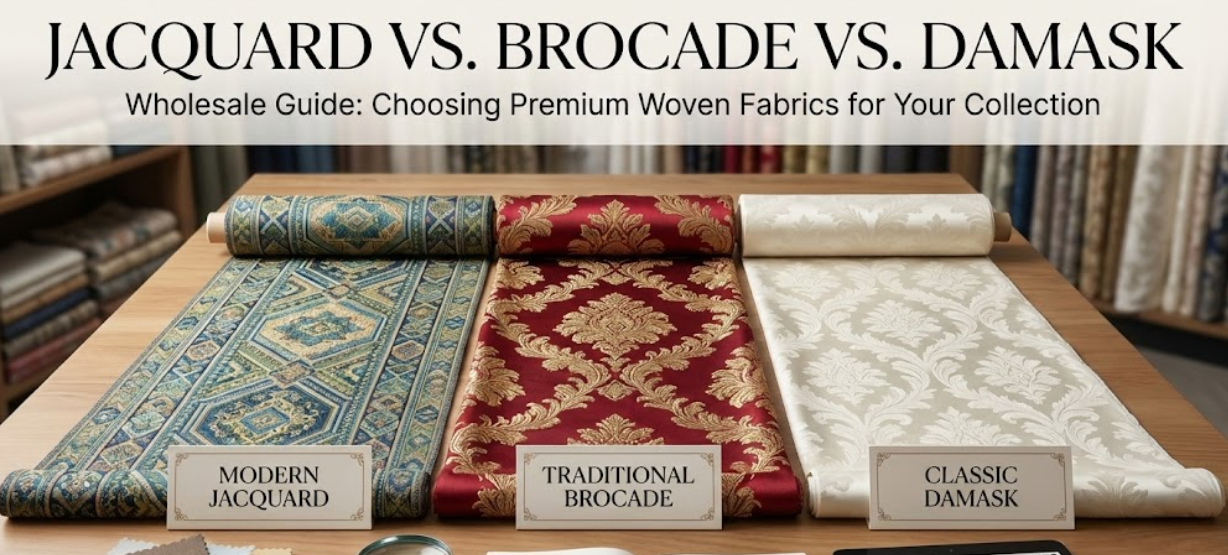
If you source textiles for fashion or home décor, you’ve likely seen jacquard, brocade, and damask described as premium fabrics—sometimes even used interchangeably. But they are not the same.
The truth is simple: jacquard is a weaving method, while brocade and damask are fabric styles commonly produced using jacquard weaving. For buyers, understanding the differences matters because each option delivers a different look, weight, and performance—directly impacting product quality, cost, and customer satisfaction.
In this article, we’ll break down what each fabric is, how they differ, when to choose which, and the exact checkpoints you should confirm before placing a wholesale order.
1) What Is Jacquard?
Jacquard refers to a weaving technique that creates patterns directly within the fabric structure. Unlike printed designs, jacquard patterns are woven—giving them more depth and typically better durability.
Key traits of jacquard fabrics
- Woven patterns (not printed)
- Can be subtle or bold, tone-on-tone or multicolor
- Can be light (for fashion) or heavy (for décor)
- Works across many fiber types (polyester, cotton, viscose, blends)
Best for: Buyers who want design flexibility and a wide range of options.
2) What Is Brocade?
Brocade is a decorative woven fabric known for its ornate, raised patterns and rich, luxurious appearance. It often uses additional yarns (sometimes metallic or shiny) to enhance the design.
Key traits of brocade
- Highly decorative, “formal” look
- Often heavier and more structured
- May include metallic effects (gold/silver tones)
- Commonly used for occasionwear and luxury décor
Best for: Formal fashion, evening pieces, statement garments, and high-impact home décor.
3) What Is Damask?
Damask is a woven fabric known for a reversible pattern and elegant, classic motifs. Traditionally, damask features a contrast between matte and sheen areas created by different weave structures.
Key traits of damask
- Often reversible (pattern visible on both sides)
- Elegant, classic motifs
- Typically smoother than brocade
- Popular in curtains, table linens, and upscale interiors
Best for: Curtains, table linens, bedding accents, and sophisticated, classic fashion detailing.
4) Quick Comparison Table (Buyer-Friendly)
Visual look
- Jacquard: Wide range—subtle to bold
- Brocade: Rich, ornate, raised, “luxury statement”
- Damask: Classic, refined, often reversible
Weight & structure
- Jacquard: Any weight depending on construction
- Brocade: Usually heavier, more structured
- Damask: Medium weight; can be structured but generally smoother
Typical uses
- Jacquard: Dresses, skirts, jackets, curtains, upholstery
- Brocade: Occasionwear, formal jackets, decorative cushions
- Damask: Curtains, table linens, classic décor textiles
5) Which One Should You Choose? (By Product Category)
A) For Dresses and Ready-to-Wear Fashion
Choose jacquard if you need:
- Softer drape
- Cleaner, modern patterns
- Easier styling for daily or semi-formal wear
Choose brocade if you need:
- Statement pieces
- Stiffer structure
- High visual impact for special occasions
Choose damask if you need:
- Elegant, classic motifs
- A refined look without heavy shine
- A premium feel suitable for modest fashion, scarves, or structured garments
Buyer tip: For fashion, always confirm drape and comfort with sample yardage, not just photos.
B) For Curtains and Home Décor
Choose damask if you need:
- Classic premium interiors
- Reversible elegance
- Controlled sheen
Choose jacquard if you need:
- Broad design variety
- Custom pattern selections
- Options from light curtains to heavy drapes
Choose brocade if you need:
- Heavy, decorative textiles
- Luxury-style interiors
- Strong statement cushions and accent pieces
Buyer tip: For curtains, confirm width, pattern repeat, and light behavior (how it looks in daylight).
6) The Specs That Matter Most (What to Ask Your Supplier)
When buying wholesale, the biggest mistakes happen when buyers only say “I want jacquard” without giving specs.
Always confirm:
- Composition (polyester, cotton, viscose, blends)
- GSM (weight) — affects drape and opacity
- Width — impacts cutting and consumption
- Pattern repeat size — affects marker efficiency and matching
- Finish (softening, luster control, anti-wrinkle)
- Color requirement — lab dips / shade control expectations
- MOQ per color/design
- Lead time and availability
7) Quality Checklist (Wholesale Approval)
Before bulk ordering, professional buyers verify:
- Pattern clarity (no distortion)
- Even weaving density
- No visible yarn pulls or weaving lines
- Shade consistency standards
- Hand-feel consistency across rolls
- Packaging suitability for export
Pro tip: Ask for real production photos or short videos under neutral lighting to confirm texture and sheen.
8) Cost Factors: Why Prices Vary
Brocade and damask can be priced higher than basic jacquard depending on:
- Pattern complexity
- Special yarns (metallic, fancy yarn)
- Higher GSM (more yarn used)
- Finishing requirements
- Color count and custom dyeing
To control cost, buyers can:
- Use tone-on-tone designs
- Select standard widths
- Choose stable, available bases
- Reduce color variations per collection
9) Common Buyer Mistakes (And How to Avoid Them)
- Approving from a photo only — always request samples.
- Ignoring repeat size — can cause production waste.
- Not defining sheen level — matte vs glossy matters.
- Skipping shade control — causes batch differences.
- Underestimating lead time — plan around production schedules.
10) Wholesale Sourcing from Shaoxing / Keqiao
Keqiao (Shaoxing) is one of the world’s strongest textile hubs. For buyers, this means:
- Fast matching and broad fabric selection
- Access to multiple constructions in one region
- Efficient sampling-to-bulk workflow
A reliable supplier helps you move from idea → sample → bulk quickly and safely.
Working With HAY Textile (Simple Wholesale Steps)
- Send your requirements (use, GSM, width, color, quantity)
- Receive matched options + pricing + MOQ
- Approve sample yardage
- Confirm bulk order + lead time
- Export-ready packing and shipping support
FAQs
Is brocade a type of jacquard?
Brocade is a fabric style often made on jacquard looms.
Is damask always reversible?
Many damasks are reversible, but it depends on the construction.
Which is best for curtains?
Damask and jacquard are common choices; the best option depends on weight, repeat, and light behavior.
Conclusion
Jacquard, brocade, and damask are all premium woven choices—but each serves a different purpose. If you want broad flexibility, go with jacquard. If you want formal luxury impact, choose brocade. If you want classic elegance and refined interiors, damask is a strong option.
Request a quote or samples:
- WhatsApp: https://wa.me/8613185551733
- WhatsApp: https://wa.me/8615068503739
- Email: 1176756151@qq.com