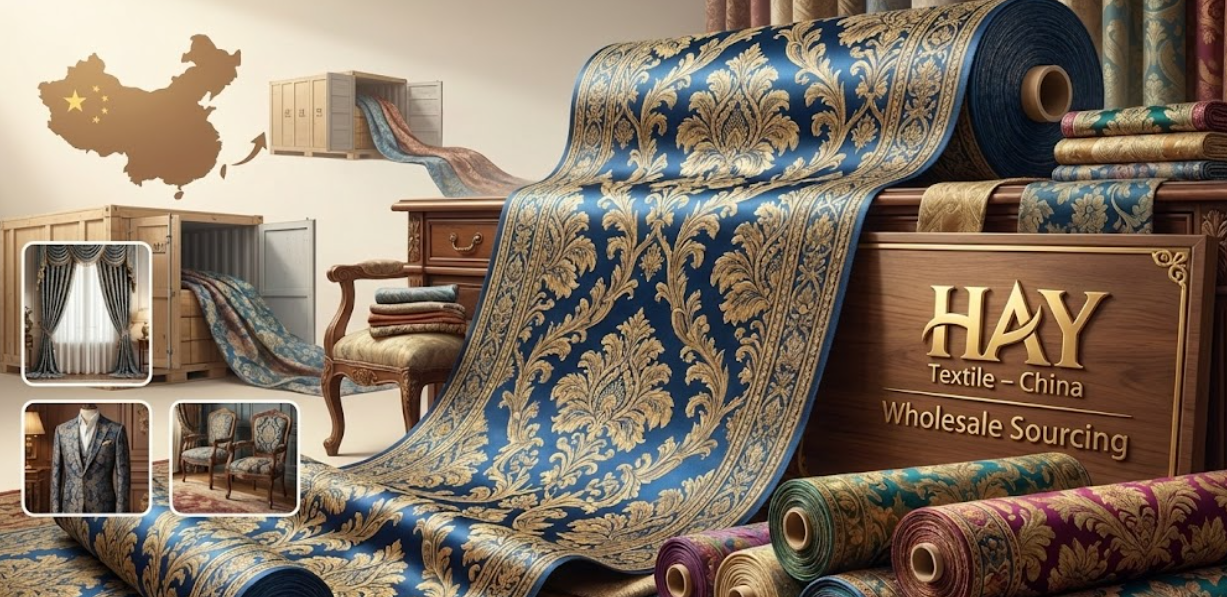
Jacquard fabric is not just “a fabric with a pattern.” It’s a weaving technique that creates designs directly into the fabric structure, producing a rich, dimensional look that instantly feels more luxurious than ordinary prints. If you’ve ever seen a fabric with elegant raised motifs, intricate florals, geometric textures, or brocade-like depth—there’s a high chance you were looking at jacquard.
For fashion brands, jacquard offers a signature look that elevates garments. For home textiles, it brings sophistication to curtains, upholstery, cushions, and bedding. And for importers or wholesalers, jacquard is a reliable premium category with strong demand across markets—especially when the quality and repeatability are controlled.
In this guide, you’ll learn what jacquard fabric is, how it’s made, the main types, common applications, and the key checkpoints to source jacquard wholesale from China—confidently and professionally.
What Is Jacquard Fabric?
Jacquard fabric is a textile created using a specialized weaving method that forms patterns by interlacing warp and weft yarns in a controlled, programmable way. Unlike printed fabric (where the design sits on top), jacquard patterns are woven into the fabric—meaning the design is part of the fabric itself.
This technique allows for:
- Complex, detailed motifs
- Multi-color woven patterns
- Raised or textured effects
- A premium “woven depth” that prints cannot replicate
Jacquard can be made from many fiber types, including polyester, cotton, viscose, silk blends, and more—depending on the final use and price target.
How Jacquard Fabric Is Made (In Simple Terms)
Jacquard weaving uses a loom system that controls individual warp threads to create complex patterns. Modern jacquard looms use digital control to precisely lift and lower threads, allowing repeatable designs at high accuracy.
What matters for buyers is the result:
- Patterns are clean and consistent
- The design repeat stays stable across meters
- The fabric structure supports the pattern (rather than relying on ink)
This makes jacquard a smart choice for brands and manufacturers that care about premium visual impact and long-term durability.
Key Advantages of Jacquard Fabric
1) Woven Patterns That Don’t Fade Like Prints
Because the pattern is built into the weave, jacquard typically holds its look longer than surface prints—especially for products that see frequent use, like upholstery or curtains.
2) Depth, Texture, and Premium Appearance
Jacquard instantly communicates “quality.” Even with simple colors, the texture creates a luxury feel.
3) Wide Design Flexibility
Jacquard can range from subtle tone-on-tone patterns to bold multi-yarn designs—making it suitable for both minimal and statement collections.
4) Strong for Fashion and Home Textiles
Jacquard can be engineered for drape (fashion) or structure (home textiles) depending on yarn selection and weave density.
5) Better Brand Differentiation
If your collection needs a distinctive signature fabric, jacquard helps you stand out. A good jacquard design can become part of the brand identity.
Types of Jacquard Fabric (Most Common Categories)
There are many variations, but these are the most common types buyers source:
1) Woven Jacquard
The standard category—patterns are created by the weave itself. Used widely in dresses, skirts, outerwear, and light home textiles.
2) Brocade Jacquard
Often heavier, more ornate, and sometimes includes metallic or shiny yarn effects. Popular for formalwear, occasion garments, and luxury décor.
3) Damask Jacquard
Typically reversible patterns with elegant, classic motifs. Common in table linens, curtains, and premium home décor.
4) Stretch Jacquard
Jacquard made with spandex or elastic yarns, offering comfort and flexibility—useful for fitted garments, fashion sets, and structured stretch pieces.
5) Polyester Jacquard (High Demand for Wholesale)
A popular choice for wholesale due to strong performance, price advantage, and high design clarity.
Best Uses of Jacquard Fabric
Fashion & Apparel
Jacquard is widely used in:
- Dresses and occasion wear
- Jackets and formal pieces
- Skirts and coordinated sets
- Abayas and premium modest fashion (depending on the design and weight)
- Structured tops and statement sleeves
If your brand wants a refined look without heavy embellishment, jacquard does the job through the fabric itself.
Home Textiles
Jacquard is a natural fit for:
- Curtains and drapes
- Upholstery and furniture coverings
- Cushion covers
- Bedding accents and decorative throws
- Table runners and premium linens
In home textiles, jacquard is valued for both its appearance and its woven durability.
How to Choose the Right Jacquard for Your Product
When sourcing jacquard wholesale, the word “jacquard” alone isn’t enough. Buyers should define clear specifications to avoid mismatches.
1) Define the End Use
- Fashion: prioritize drape, softness, and comfort
- Curtains: prioritize stability, width options, and light behavior
- Upholstery: prioritize durability, abrasion resistance, and structure
2) Confirm GSM and Fabric Weight
GSM (grams per square meter) affects:
- Draping vs stiffness
- Opacity
- Seasonality
- Stitch stability
If you want a more “flowy” garment, choose lighter GSM. For structured looks or upholstery, go heavier.
3) Check Width and Repeat Size
For manufacturing efficiency, confirm:
- Fabric width (common options vary)
- Pattern repeat size (important for cutting and alignment)
Large repeats can look premium but may increase fabric waste in production.
4) Validate Color Consistency
Color and yarn shade stability are critical for wholesale orders. Always request:
- Lab dips (when applicable)
- Sample meter approval
- Clear confirmation of batch consistency standards
5) Ask About Finishing
Finishing impacts feel and performance:
- Softening finishes
- Anti-wrinkle options
- Luster control (matte vs sheen)
- Shrinkage behavior
A good finish can transform the final quality perception.
Quality Checklist for Wholesale Jacquard Orders
Before placing bulk orders, professional buyers usually confirm:
- Pattern clarity (clean edges, no distortion)
- Weave density (consistent across width and length)
- No yarn pulling or weak points
- Colorfastness expectations (especially for home textiles)
- Minimal weaving defects and controlled tolerance
- Stable hand-feel (not changing across rolls)
- Packaging method suitable for export shipping
If you’re sourcing from China, these checkpoints protect your production timeline and customer satisfaction.
Why Source Jacquard from Shaoxing / Keqiao?
Keqiao (Shaoxing, Zhejiang) is recognized as one of the world’s strongest textile clusters, with wide fabric variety and strong production capacity. For buyers, this means:
- More options for patterns and constructions
- Faster sourcing and fabric matching
- Strong supply network for large-scale orders
- Easier sampling-to-bulk transition
Working with a supplier based in Shaoxing/Keqiao helps you move faster and access broader fabric choices.
Working with HAY Textile: A Practical Wholesale Process
At HAY Textile (Shaoxing, China), our goal is to make sourcing simple, clear, and export-ready. A smooth wholesale process often looks like this:
- Share your fabric requirements
Composition, GSM, width, colors, and quantity (or send a sample photo). - Receive matched options
Available qualities, pattern suggestions, and practical recommendations. - Confirm MOQ, pricing, and lead time
Clear timelines help your production schedule stay stable. - Sampling (if needed)
Sample yardage or swatches for approval before bulk. - Bulk production & packing coordination
Export-ready packing and documentation support.
If you want faster matching, the best approach is to send your target GSM + width + intended use + a reference image.
FAQs: Jacquard Fabric (Buyer Questions)
1) Is jacquard fabric printed?
No. Jacquard patterns are woven into the fabric structure, not printed on top.
2) Is jacquard suitable for everyday wear?
Yes—depending on the construction. Some jacquards are soft and wearable daily, while others are heavier and best for formal pieces.
3) Can jacquard be used for curtains?
Absolutely. Jacquard is a premium choice for curtains because it holds shape well and provides rich visual texture.
4) Is jacquard fabric expensive?
It can be higher than basic plain weaves, but price varies widely by fiber type, complexity, and finishing.
5) How do I choose jacquard for dresses?
Focus on drape, GSM, softness, and comfort—then confirm color and repeat size for cutting efficiency.
6) Is polyester jacquard a good option?
Yes. Polyester jacquard is popular wholesale because it offers clear patterns, strong performance, and cost efficiency.
7) What information should I send for a quote?
GSM, width, composition (if known), colors, quantity, and intended use (fashion/curtains/upholstery).
8) Can I order samples before bulk?
Yes. Sampling is recommended for confirming hand-feel, pattern clarity, and color expectations.
Conclusion: Jacquard Is the Fabric That Sells “Premium” Instantly
Jacquard fabric remains one of the strongest premium categories in both fashion and home textiles—because it delivers design depth, texture, and long-lasting visual value. With the right specifications and quality checkpoints, you can source jacquard wholesale confidently and build collections that look more expensive and feel more refined.
If you’re sourcing jacquard from China, the key is clear requirements and a supplier that understands repeatability, export readiness, and buyer expectations.
Call to Action (Contact / Inquiry)
Request a Quote or Samples
Share your jacquard requirements (GSM, width, color, quantity), and we’ll respond with available options, MOQ, pricing, and lead time.
- WhatsApp: https://wa.me/8613185551733
- WhatsApp: https://wa.me/8615068503739
- Email: 1176756151@qq.com